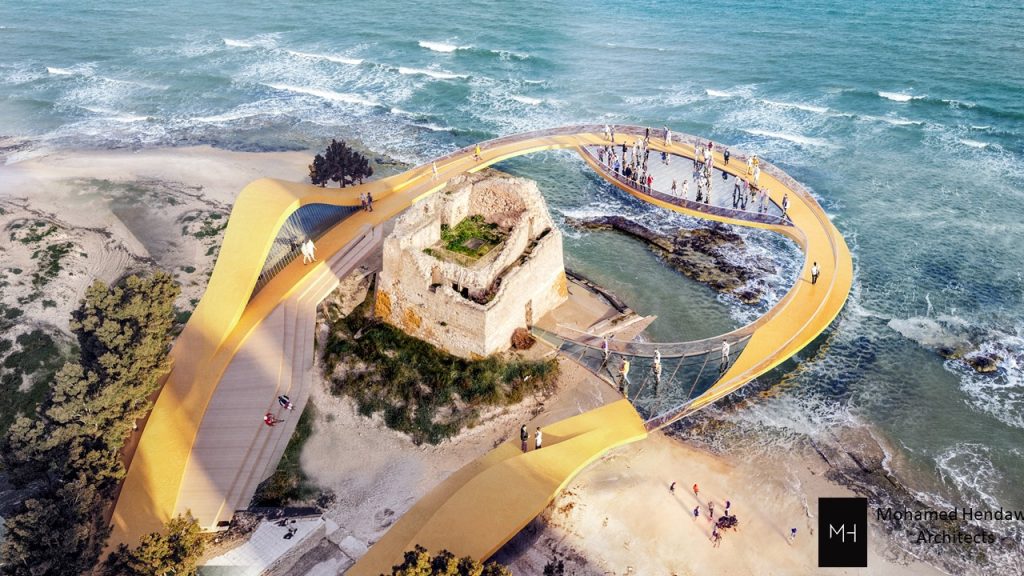
MH Architects, led by Architect Mohamed Hendawi, was shortlisted in an international competition for the adaptive reuse of a historical ruin on the Italian coastline. The proposal transforms an abandoned stone tower into a living cultural landmark — preserving its history while reconnecting it with the surrounding landscape, sea, and community
Design Concept
The main design approach was to protect and celebrate the ruin without altering its historic fabric, while creating a new layer of public space around it. A continuous curved walkway, rendered in warm gold tones, wraps around the historic structure like a ribbon — linking the beach, the ruin, and the sea into a single uninterrupted experience.
The circular form of the walkway echoes the surrounding coastline and tidal pools, creating a natural viewing platform that draws visitors toward the water while framing the ancient tower as the space’s centerpiece
Layout & Circulation
The layout was carefully designed to preserve the ruin’s footprint at the center, while the surrounding golden pathway forms a loop connecting multiple entry points from the beach, dunes, and coastal town. A partially submerged plaza extends toward the rocks, allowing visitors to walk closer to the sea without disturbing the natural tidal ecosystem.
Adaptive Reuse Approach
Rather than restoring or rebuilding the historic tower, the design intentionally leaves the ruin untouched — allowing its weathered stone and open roof to remain a visible record of history. The new walkway touches the structure only lightly, creating a respectful dialogue between old and new
Community & Cultural Use
The space is designed to host cultural and community activities — from art workshops to open-air exhibitions — turning the historic site into a living gathering place rather than a fenced-off monument. Locals and visitors alike can sit on the surrounding steps, paint, or simply take in the coastal views framed by the ruin and the sea
By weaving a modern, sculptural walkway around a centuries-old ruin, the project reframes heritage not as something to be preserved behind glass, but as a living part of everyday life — connecting past and present through shared public space